

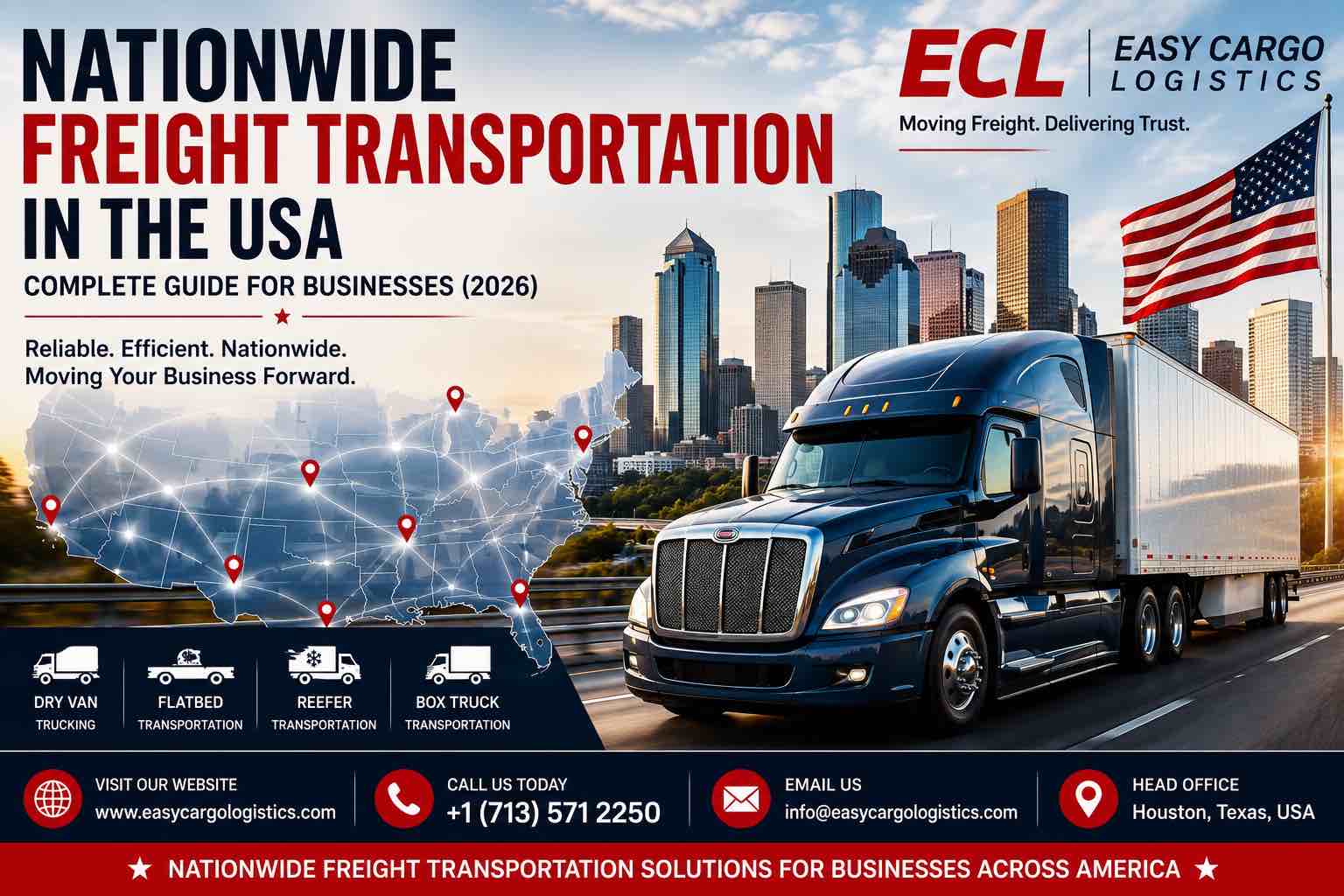
Nationwide Freight Transportation in the USA: Complete Guide for Businesses
Every day, businesses across the USA depend on reliable freight transportation to keep manufacturing lines running, replenish warehouse inventory, deliver retail products, supply construction projects, and fulfill customer orders. Behind this continuous movement is an extensive American transportation network connecting suppliers, factories, distribution centers, ports, warehouses, retailers, and customers from coast to coast.
For companies operating within the United States, Nationwide Freight Transportation is much more than moving cargo between two locations. It is a critical part of supply chain management that directly affects delivery performance, inventory availability, customer satisfaction, operational efficiency, and business growth.
Easy Cargo Logistics (ECL) is a Houston, Texas-based logistics company providing
Nationwide Freight Transportation Services
for businesses moving commercial cargo across Texas and throughout America. Our logistics team coordinates domestic freight movement through dependable carrier communication, route planning, compliance support, shipment visibility, and transportation solutions tailored to each customer’s operational requirements.
This guide explains how nationwide freight transportation in the USA works, which transportation methods are available, what factors affect freight planning, and how professional logistics coordination helps businesses move commercial cargo safely and efficiently across the country.
Estimated Reading Time: 10–12 minutes
Last Updated: July 2026
Written By: Easy Cargo Logistics Editorial Team
Reviewed By: Freight Transportation and Supply Chain Specialists
Key Takeaways
- Nationwide freight transportation connects businesses with suppliers, warehouses, distribution centers, and customers throughout the USA.
- Transportation options include Dry Van, Flatbed, Reefer, Box Truck, Hotshot, Full Truckload, and Less Than Truckload services.
- The best freight method depends on cargo size, weight, dimensions, temperature requirements, delivery schedule, and destination.
- Professional logistics coordination improves route planning, carrier communication, shipment visibility, and delivery reliability.
- Easy Cargo Logistics supports businesses with customized commercial freight transportation across Texas and the United States.
What Is Nationwide Freight Transportation?
Nationwide freight transportation is the coordinated movement of commercial goods, equipment, materials, and products between locations across the United States. It may involve transportation within one state, movement between neighboring regions, or long-haul shipping from one side of America to the other.
A nationwide shipment may travel from a Houston manufacturing facility to a distribution center in Chicago, from a California supplier to a retailer in New York, or from a warehouse in Florida to customers across several Midwestern states. Each shipment requires proper equipment selection, route planning, scheduling, documentation, carrier coordination, and communication.
Businesses often work with an experienced logistics company because freight transportation involves more than securing a truck. The transportation plan must account for cargo dimensions, weight, handling requirements, pickup and delivery appointments, route restrictions, transit expectations, equipment availability, and regulatory considerations.
Professional
Road Freight Services USA
help bring these responsibilities together within one coordinated process, giving businesses a more dependable method for moving cargo across America.
Why Nationwide Freight Transportation Matters to U.S. Businesses
American supply chains depend on consistent freight movement. Manufacturers need raw materials and components delivered before production begins. Distributors require regular replenishment to maintain inventory. Retailers depend on scheduled deliveries to keep shelves stocked, while construction, healthcare, energy, and technology companies often need specialized materials delivered within strict timelines.
Transportation delays can lead to production stoppages, inventory shortages, missed customer commitments, additional storage expenses, and higher operating costs. An effective nationwide freight transportation strategy helps reduce these risks by matching each shipment with the right equipment, route, carrier capacity, and delivery plan.
Reliable freight transportation services in the USA also allow businesses to expand beyond their immediate region. A company based in Texas can serve customers on the East Coast, source materials from the Midwest, distribute inventory throughout the South, and reach commercial markets across the country without establishing its own private transportation fleet.
How Nationwide Freight Transportation Works
Although every commercial shipment has different requirements, nationwide freight transportation generally follows a structured process.
1. Shipment Information Is Collected
The transportation provider first reviews the pickup location, destination, cargo description, dimensions, total weight, number of pallets or units, requested dates, and special handling requirements. Accurate shipment information is essential because it determines the equipment, capacity, route, and estimated transportation cost.
2. The Appropriate Freight Method Is Selected
A palletized consumer product may travel in a dry van, refrigerated food may require a temperature-controlled trailer, and oversized industrial equipment may need a flatbed. Smaller regional shipments may be suitable for a box truck, while high-volume commercial cargo may require a full truckload.
3. Route and Capacity Are Coordinated
The logistics team evaluates available carrier capacity, practical routes, transit expectations, pickup appointments, delivery windows, and possible restrictions. For long-distance transportation across the USA, careful route planning can reduce unnecessary delays and improve delivery performance.
4. The Shipment Is Monitored
During transit, communication and freight visibility help businesses understand shipment progress and prepare for delivery. Proactive coordination is especially important when weather, traffic, facility delays, or appointment changes affect the original transportation schedule.
5. Delivery Is Confirmed
After the cargo reaches its destination, delivery documentation confirms completion of the shipment. Proper records also support invoicing, customer communication, freight claims, and internal supply chain reporting.
Major Types of Nationwide Freight Transportation Services
No single truck or trailer is suitable for every shipment. The following transportation methods serve different commercial cargo requirements across America.
Dry Van Trucking Services
Dry Van Trucking Services
are widely used for palletized, packaged, and non-temperature-sensitive freight. Enclosed trailers protect cargo from weather and road exposure, making them suitable for consumer goods, retail products, packaged foods, electronics, automotive components, manufacturing materials, and general commercial merchandise.
Dry vans are often selected for both regional and long-haul transportation because they offer broad availability, enclosed protection, and flexibility across many industries.
Flatbed Trucking Services
Flatbed Trucking Services
support freight that cannot be loaded conveniently through standard trailer doors or that exceeds conventional enclosed-trailer dimensions. Flatbeds allow loading from the side, rear, or above and are frequently used for steel, lumber, construction materials, industrial machinery, pipes, equipment, and oversized cargo.
Successful flatbed transportation may require securement planning, tarping, dimensional review, and route evaluation. Businesses should provide complete cargo measurements before requesting transportation.
Reefer Trucking Services
Reefer Trucking Services
use temperature-controlled trailers for products that must remain within a defined temperature range. Typical cargo includes food and beverages, frozen products, produce, pharmaceuticals, healthcare supplies, floral products, and temperature-sensitive ingredients.
Refrigerated transportation requires accurate temperature instructions, suitable packaging, loading discipline, and consistent shipment monitoring to protect product integrity throughout the journey.
Box Truck Transportation Services
Box Truck Transportation Services
are suitable for smaller commercial shipments, regional distribution, scheduled deliveries, retail replenishment, local transportation, and cargo that does not require a full-size tractor-trailer.
Box trucks can provide flexible access to urban locations, commercial buildings, retail stores, and facilities where larger equipment may be difficult to position. Liftgate and inside-delivery requirements should be communicated during freight planning.
Full Truckload Transportation
Full Truckload, commonly called FTL, generally means that one shipper uses most or all of a trailer’s available capacity. FTL can be appropriate for large shipments, high-value cargo, time-sensitive deliveries, dedicated transportation, or freight that should experience minimal handling between pickup and delivery.
Because the cargo normally remains on the same trailer, FTL transportation may provide more direct routing and fewer transfer points than shared freight options.
Less Than Truckload Transportation
Less Than Truckload, or LTL, allows multiple shippers to share trailer capacity. It can be a cost-effective option for freight that is too large for parcel shipping but does not require an entire trailer.
LTL pricing and planning may consider shipment weight, dimensions, density, freight class, origin, destination, accessorial requirements, and delivery service level. Strong packaging and accurate documentation are particularly important because LTL cargo may pass through terminals during transit.
Hotshot and Expedited Freight
Hotshot and expedited transportation support urgent, time-sensitive, or specialized shipments that need faster coordination. These solutions may be used for replacement parts, industrial equipment, construction materials, emergency inventory, and cargo required to prevent operational downtime.
Industries That Depend on Freight Transportation Across America
Nationwide transportation supports nearly every sector of the U.S. economy. Common users include:
- Manufacturing: Raw materials, components, machinery, finished products, and production supplies.
- Retail and E-commerce: Inventory replenishment, regional distribution, and customer fulfillment.
- Construction: Building materials, steel, lumber, tools, machinery, and job-site equipment.
- Food and Beverage: Packaged goods, ingredients, produce, frozen products, and refrigerated freight.
- Healthcare: Medical equipment, healthcare supplies, and temperature-sensitive products.
- Automotive: Replacement parts, components, tires, tools, and manufacturing materials.
- Energy and Industrial Operations: Machinery, pipes, components, oilfield supplies, and project cargo.
- Wholesale and Distribution: Palletized inventory moving between suppliers, warehouses, and commercial customers.
Factors That Influence Freight Transportation Costs
The cost of freight transportation services in the USA depends on several shipment-specific and market-related factors.
- Distance: Longer routes normally require more fuel, driver time, and operating resources.
- Weight and dimensions: Larger or heavier freight uses more trailer capacity and may require specialized equipment.
- Equipment type: Refrigerated, flatbed, expedited, or specialized transportation may carry different costs than standard dry van service.
- Pickup and delivery conditions: Liftgates, limited access, residential delivery, inside service, appointments, and waiting time can affect pricing.
- Urgency: Expedited or time-critical freight may require dedicated capacity and faster coordination.
- Market capacity: Carrier availability, seasonality, fuel conditions, weather, and regional demand can influence rates.
- Special handling: Fragile, oversized, high-value, or temperature-sensitive cargo may require additional planning.
Businesses receive more accurate transportation proposals when they provide complete shipment details at the beginning of the quoting process.
How to Choose a Nationwide Freight Transportation Partner
Choosing a transportation provider should not be based on price alone. An unrealistically low rate may create service problems if equipment, carrier capacity, communication, or shipment requirements are not properly managed.
Businesses should evaluate whether a logistics partner can:
- Understand the cargo and recommend suitable equipment.
- Coordinate pickups and deliveries across multiple U.S. regions.
- Provide clear shipment communication and visibility.
- Handle documentation and operational requirements accurately.
- Respond quickly when schedules or transportation conditions change.
- Support repeat shipments and long-term supply chain needs.
- Connect domestic transportation with broader commercial logistics services.
Businesses with both domestic and global cargo requirements may also benefit from working with a provider offering
International Freight Forwarding Services
and
Commercial Freight Forwarding Solutions.
This creates continuity between international arrival, port or airport handling, inland transportation, warehousing, and final delivery.
Safety and Regulatory Considerations
Commercial freight transportation in America operates within federal and state regulatory frameworks. Businesses and transportation professionals can review carrier-safety and motor-carrier information through the
Federal Motor Carrier Safety Administration.
Broader information about national transportation policy and infrastructure is available from the
U.S. Department of Transportation.
Shipment-specific requirements may vary based on equipment, cargo type, dimensions, weight, route, and handling needs. Accurate information should therefore be shared before transportation is arranged.
How Easy Cargo Logistics Supports Nationwide Freight Movement
Easy Cargo Logistics coordinates commercial freight transportation from Houston, Texas to destinations across the USA. Our approach begins by understanding the shipment, its business purpose, delivery expectations, cargo characteristics, and operational requirements.
We then help coordinate suitable equipment, route planning, carrier communication, pickup and delivery appointments, freight visibility, and shipment documentation. Our domestic transportation capabilities include Dry Van, Flatbed, Reefer, Box Truck, Hotshot, FTL, and LTL solutions.
ECL also supports companies whose supply chains extend beyond the United States through integrated logistics and
Global Trade and Integrated Logistics Solutions.
This allows businesses to connect international cargo movement with dependable inland freight transportation across America.
Frequently Asked Questions
What is nationwide freight transportation?
It is the coordinated movement of commercial cargo between cities, states, facilities, and markets throughout the United States using suitable trucking and logistics solutions.
What types of freight can be transported across the USA?
Businesses can transport palletized goods, retail products, manufacturing materials, machinery, construction supplies, refrigerated products, equipment, and many other forms of commercial cargo, subject to equipment and regulatory requirements.
What is the difference between FTL and LTL?
FTL generally uses most or all of a trailer for one shipper, while LTL combines smaller shipments from several customers within shared trailer capacity.
When should a business use dry van transportation?
Dry vans are generally appropriate for packaged, palletized, and non-temperature-sensitive cargo requiring enclosed protection during transportation.
When is flatbed transportation required?
Flatbeds are often used for oversized, unusually shaped, heavy, or side-loaded cargo such as machinery, steel, pipes, lumber, and construction materials.
What products require reefer transportation?
Reefer trailers are used for freight requiring controlled temperatures, including certain foods, beverages, produce, frozen products, pharmaceuticals, and healthcare supplies.
How long does nationwide freight transportation take?
Transit time depends on origin, destination, distance, equipment, route, delivery schedule, weather, capacity, and whether the service is standard or expedited.
What information is needed for a freight quote?
The transportation provider generally needs pickup and delivery locations, freight description, dimensions, weight, pallet count, requested dates, equipment needs, and special service requirements.
Does ECL provide transportation outside Texas?
Yes. Easy Cargo Logistics coordinates nationwide freight transportation across Texas and throughout the United States.
Can ECL support both domestic and international shipments?
Yes. ECL provides nationwide transportation, international freight forwarding, commercial freight coordination, air freight, ocean freight, and integrated logistics support.
Related ECL Freight Services
- Nationwide Freight Transportation Services
- Road Freight Services USA
- Dry Van Trucking Services
- Flatbed Trucking Services
- Reefer Trucking Services
- Box Truck Transportation Services
Move Commercial Freight Across the USA with Confidence
Nationwide freight transportation is a vital part of modern American commerce. The right transportation strategy helps businesses maintain inventory, support production, reach new customers, reduce supply chain interruptions, and move commercial cargo reliably from coast to coast.
Easy Cargo Logistics provides customized freight transportation services for businesses shipping across Texas and throughout the USA. Whether your cargo requires Dry Van, Flatbed, Reefer, Box Truck, Hotshot, FTL, or LTL transportation, our logistics team can help coordinate a dependable solution based on your shipment requirements.
Request a Freight Quote
or
contact Easy Cargo Logistics
to discuss your nationwide transportation requirements.
Leave a Reply